Friendship is the most valuable as well as precious gifts of life. Friendship is one of the most valued relationship. People who have good friends enjoy the most in their live. True friendship is based on loyalty & support. A good friend is a person who will stand with you when times are tough. A friend is someone special on whom you can rely on to celebrate a special moment. Friendship is like a life asset and it can lead us to success. It all depends on our choice how we choose our friends. The quality of friendship is essential for happiness. The benefits of healthy friendship remains long-life. In addition, having a strong friend circle also improves our self-confidence. Due to the strong relationship, we get much emotional support during our bad times. True friendship is a feeling of love & care. Real friendship cannot be built within limited boundaries like caste or creed. It gives us a feeling that someone really needs us & we are not alone. This is true that man cannot live alone. True friends are needed in every stage of life to survive. A true friend can be an old person or a child. But it is generally believed that we make friend with people who are of the same age as ours.
Whatever we see around us, right from the moment we step out of our house is part of nature. The trees, flowers, landscapes, insects, sunlight, breeze, everything that makes our environment so beautiful and mesmerizing are part of Nature. In short, our environment is nature. Nature has been there even before the evolution of human beings.Studies and research have shown that children especially have a natural affinity with nature. Regular interaction with nature has boosted health development in children. Nature supports their physical and mental health and instills abilities to access risks as they grow.
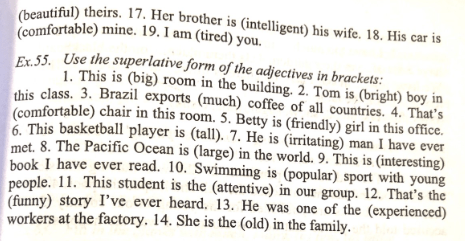
1Read this story.2This more intersting than that.3This work best.4.David is their bigest son․5.Winter in Georgia soter than Armenia.6.It’s winter.Very cold.7.Don’t go outside without hat.8.This exercise also difficult as that.9.Leonardo biggest in our group.
1.last
2.furthest
3.last novel
4.next
5.next stop
6.older, elder
7.eldest
8.further
9.oldest
10.later
1.warmer
2.more
3. shorthest
5. best
6. smallest
7.worst
8.oldest
1.Scotland 2. Ararat 3. in house 4.at resturant 5.cold 6.watch TV
For me, friendship is one of the meanings of life. Without a friend, I won’t be able to share the thoughts and secrets that I can’t tell my parents. All my friends are different. One cannot keep a secret, the other gets upset, one is always ready to listen, the other always helps. I can’t imagine my life without friends. In my opinion, all friends are equal and I can’t choose a close or better friend among them. Friendship is a miracle for me, without which I cannot imagine my life.For me, friendship is one of the meanings of life. Without a friend, I won’t be able to share the thoughts and secrets that I can’t tell my parents. All my friends are different. One cannot keep a secret, the other gets upset, one is always ready to listen, the other always helps. I can’t imagine my life without friends. In my opinion, all friends are equal and I can’t choose a close or better friend among them. Friendship is a miracle for me, without which I cannot imagine my life.
Ernest Miller Hemingway was an American author and journalist. He was born on July 21, 1899 in Oak Park, Illinois, where he was raised. He died on July 2, 1961 in Ketchum, Idaho, where he committed suicide.
Hemingway’s economical and understated style had a strong influence on 20th-century fiction, while his life of adventure and his public image influenced later generations. Hemingway produced most of his work between the mid-1920s and the mid-1950s, and won the Nobel Prize in Literature in 1954. He published seven novels, six short story collections, and two non-fiction works. Three novels, four collections of short stories, and three non-fiction works were published posthumously.
After finishing high school, Hemingway reported for a few months for The Kansas City Star, before leaving for the Italian front to enlist with the World War I ambulance drivers where he was wounded in 1918 and returned home. Hemingway’s experiences in wartime formed the basis for his novel A Farewell to Arms. In 1922, he married Hadley Richardson, the first of his four wives. The couple moved to Paris, where he worked as a foreign correspondent, and fell under the influence of the modernist writers and artists of the 1920s “Lost Generation” expatriate community. The Sun Also Rises, Hemingway’s first novel, was published in 1926.
Hemingway married Pauline Pfeiffer after his 1927 divorce from Hadley Richardson. However this marriage was also unsuccessful and the couple divorced after Hemingway returned from the Spanish Civil War where he had been a journalist. Drawing from his experience in the Spanish Civil War, Hemingway published For Whom the Bell Tolls. He married his third wife, Martha Gellhorn in 1940. They separated when he met Mary Welsh in London during World War II.
Shortly after the publication of The Old Man and the Sea, one of his masterpieces, in 1952, Hemingway went on safari to Africa, where he was almost killed in two successive plane crashes that left him in pain or ill health for much of the rest of his life. Hemingway had permanent residences in Key West, Florida, and Cuba during the 1930s and 1940s, but in 1959 he moved from Cuba to Ketchum, Idaho, where he put an end to his life in the summer of 1961.
A typical day in Lisa’s life Her mother always wakes her up at seven o’clock. She gets up and goes to the bathroom. There she washes and brushes her teeth. Then she walks downstairs and has breakfast. Then she says goodbye to her parents and leaves the house. She usually catches the bus to school where she meets some friends. After school she does her homework and studies for a test. Then she chats with her friends, reads a book or watches one of her favorite sitcoms.
Fill in the gaps with the correct form of the verbs in brackets.
My uncle buys a new laptop every year. (buy) Claire and Zoe bake a cake for my birthday every year. (bake) My sister tries hard and that’s why she never fails. (try / fail) Ashley and her friends play in the park every weekend. (play) Our dog chases our neighbor’s cat in the garden. (chase)
Form questions in the present simple with the words given.
What / you / have / for breakfast — What do you have for breakfast? When / he / come / on Fridays — When does he come on Fridays? How often / she / go out / with her friends — How often does she go out with her friends? Your brother / live / in England — Does your brother live in England? The kids / like / their new English teacher — Do the kids like their new English teacher? Put the words into the correct order. Write down the sentences.
visit / they / sometimes / on Sunday / their aunt — They sometimes visit their aunt on Sunday. you / to the mall / go / often / with your friends — Do you often go to the mall with your friends ? a tennis match / hardly ever / watches / he — He hardly ever watches a tennis match. usually / have / we / dinner / before seven / don’t — We don’t usually have dinner before seven. read / the paper / always / she / in the morning — Does she always read the paper in the morning ?
Fill in the Blanks with Correct Simple Present Tenses.
1. Sarah and Pam often go to parties. (go) 2. Jenny sometimes meets Monica. (meet) 3. In summer children usually play in the garden. (play) 4. Sally often cleans the board. (clean) 5. My sister has blue eyes. (have) 6. Bill opens the window. (open) 7. Barbara thinks school uniforms look great. (think) 8. They all wear dark blue pullovers. (wear) 9. He often does the housework. (do) 10. My mum goes shopping every Friday. (go) 11. I never watch TV in the morning. (watch) 12. She likes her new notebook. (like) 13. Fred plays football every Saturday. (play) 14. Hannah and Betty often eat pizza. (eat) 15. Frank sometimes has a headache. (have)
Fill in the Blanks with Correct Simple Present Tenses.
The Principal wants to speak to Raj. (want) The Earth revolves round the Sun. (revolve) The baby cries all day. (cry) The flight leaves at 8 o’clock in the morning. (leave) What smells so good? (smell) Hema plays badminton every evening. (play) Tony goes to guitar lessons every Sunday. (go) If it rains today, we will get stuck. (rain) The nurse takes care of my grandfather. (take care) There comes the topper of our school. (come) I get up at 7:00 a.m. every day. (get) Amy rarely leaves her room. (leave) Cows give us milk. (give) My granny cooks delicious lasagna. (cook) The birds chirp all day long. (chirp) The boys study hard to get good grades. (study) The teacher meets the parents today. (meet) The movie resumes within a few minutes. (resume) The fluffy clouds fly around. (fly) The dogs bark at night. (bark)
1)Worldwide, a whopping one in sixteen adults make use of BBC News.
2)Predictably for such a well-known organization, the BBC has acquired several nicknames. Among them are “the Beeb” and more affectionately, “Auntie.”
3)Not only is the BBC the world’s largest broadcaster by the number of people employed, but it is also the world’s oldest national broadcasting organization. It turned 98 years old in 2020!
4)Recently, a poll was done across 14 different countries, asking which TV station was the best overall. Out of 66 channels, the BBC took the number one spot!
5)Aside from radio, television, and film, the BBC also has a branch which focuses on books and magazines. Owned by Random House, BBC Books has published several books over the years, many of which are tie-ins to the BBC’s shows (ex. Doctor Who). There is also BBC Magazines, which produces such diverse titles as Radio Times and Gardens Illustrated.
6)In total, 96% of the U.K.’s population either listens to or watches programs by the BBC. This includes two thirds of all adults in the U.K. who listen to BBC radio stations.
7) In the final year of 2016/2017, the BBC’s total revenue was £4.954 billion! For those of you who don’t have the conversion rate memorized (yes, we see you there), that would translate to just under 6.5 billion U.S. dollars!]
The British Broadcasting Company was established in 1922. Four years later, it changed its name to the British Broadcasting Corporation, better known as the BBC, and that is how it has remained ever since. It was not the world’s first radio station. There had already been public radio broadcasts in Britain before 1920, and by 1922 radio stations were operating in Russia and in America. In the Soviet Union, radio was owned, operated and rigidly controlled by the state. In the USA it was a great new adventure for free enterprise. With its new idea of public service broadcasting, the British government chose the middle road.
From the beginning the BBC was a public service radio, but also an independent operator. Except during the war years, it has never been controlled by the government. On the contrary, several British government ministers have complained, over the years, that the BBC was biased against them! In the early days of BBC radio, there was not a lot of news on the radio. There were music, drama, discussions and children’s programs; but news was not broadcast until after 7 p.m., to avoid competition with the newspapers! In 1936 the BBC began the world’s first television service. Only a few thousand people in the London area could receive those first flickering images, which were broadcast using a screen of just 204 lines. Today we have 625 lines on ordinary television, and even more for HDTV. Nevertheless, people liked what they saw, and as the number of transmitters increased, more and more people went out to buy new television sets. In 1937, tennis was broadcast from Wimbledon for the first time. Then in 1938, football’s Cup Final could be seen, live, by hundreds of thousands of people, for the first time ever. Yet on September 1st, 1939, in the middle of a Mickey Mouse cartoon, BBC TV stopped broadcasting. The Second World War had begun. It was not until June 8th 1946, on the day of the great Victory Parade, that BBC television started again. Since then the BBC has become one of Britain’s most famous institutions. Today it has several national television channels, lots of radio channels and a growing number of international services. It also has a very popular Internet site, with news stories from Britain and around the world. As far as program production is concerned, the BBC is Europe’s biggest and most successful exporter of audio-visual material. In International competitions, the BBC regularly wins more prizes than other broadcasters. In tomorrow’s world, communications and the media will become more and more important. With almost 100 years of experience, the BBC is determined to remain one of the world’s major players.
WORD GUIDE broadcasting: transmitting radio or television
— quest: search
ex. The quest work was so difficult.
— events: things that happen, news
ex. The most popular event of this month was the New King’s coronation.
— reliable: dependable
ex. We must be a reliable wall for our nation.
— established : started
ex. Four days ago, the news about death of the queen Elizabeth II were established.
— remained : continued
ex. The war has remained.
— biased: partial, discriminating
The BBC was biased against them!
— flickering: poor quality
The mobile phone has a poor quality.
— to avoid competition: so as not to compete
The nation was avoiding competition against enemies.
— television set: a television
The television set was a in the beautiful pack.
Here are the answers to a number of questions. Produce appropriate questions, using the prompts given.
1. How many people listened to it? Answer: Millions listened to it. 2. When the company changed its name BBC? Answer: In 1926, after four years of broadcasting. 3. Why the news was shown until 7pm but there was lots of music, discussions and dramatic films. Answer: In order to avoid competing with newspapers. 4. What was the highest point reached by the company in 1936. Answer: They launched the world’s first television service. 5. How many screen lines were on the tablet, if only a few thousand people in the London area could receive those first flickering images. Answer: Just 204 — compared to 625 in modern systems. 6. Why on September 1st, in the middle of the cartoon, the translation was stopped? Answer: Because the Second World War had just begun


 Յանա Սարդարյան